

“Mind the gap” has warned London commuters for decades that the dangerous part of the journey isn’t the train or the platform — it’s the space between them. Six gaps punctuate the distance between where we are and where we’re going: polls vs. votes, AI capex vs. revenue, government spending vs. collections, cyber exploits vs. patches, Chinese factories vs. everyone else’s, the wealthiest vs. the rest. Gaps don’t persist forever. The most critical question for 2027: will they close quietly… or violently?
1. The Elections Gap: Are the Senate polls wrong again?
“Applying the historical trend to this year’s polls reverses Democratic leads in the pivotal states of Alaska and Texas. In Ohio the Democratic advantage would be cut to less than one percentage point, while Iowa and Kansas would move from being tied to leaning Republican.” (The Economist)

2. The AI Money Gap: Can AI builders earn enough to pay for the build-out?
“AI data center owners would need to generate a cumulative $8.5 trillion in revenue… [but are] forecast to reach no more than $3.6 trillion.” That’s a $4.9 trillion revenue gap. (Gartner)

3. The Fiscal Gap: How long can we run $2 trillion deficits before lenders set the budget?
Washington spent $7.4 trillion in fiscal 2026 while collecting $5.4 trillion — a $2 trillion annual deficit that CBO expects to widen. CBO puts the debt we owe investors at 101% of GDP this year — above 100% for the first time since 1946 — and projects it will break the WWII record of 106% by 2030. (CBO)

4. The Cyber Gap: Can AI-enabled defenders catch up to AI-empowered attackers?
Welcome to “Black October”… “The sharp increase in hacks is part of a dizzying AI-driven acceleration of cybersecurity threats that is rippling around the world. At the same time as new tools speed up hackers, cyber defenders are also racing to fix the fast-growing volume of security bugs discovered by AI, before hackers can exploit the new flaws.” (WSJ, 10/24/26, “AI Hacks Are Coming Thick and Fast and Overwhelming the Internet”)

Kicker: “Roughly half the critical software vulnerabilities ever found have been found this year alone.” — Paul Kedrosky
5. The China Gap: Can anyone compete with China’s factories?
“China’s gaping manufacturing trade surplus has become a symbol of overcapacity concerns. It has reached an eye-popping $2 trillion in nominal terms, driven by a near-relentless rise in exports paired with much slower import growth.” (Brookings)

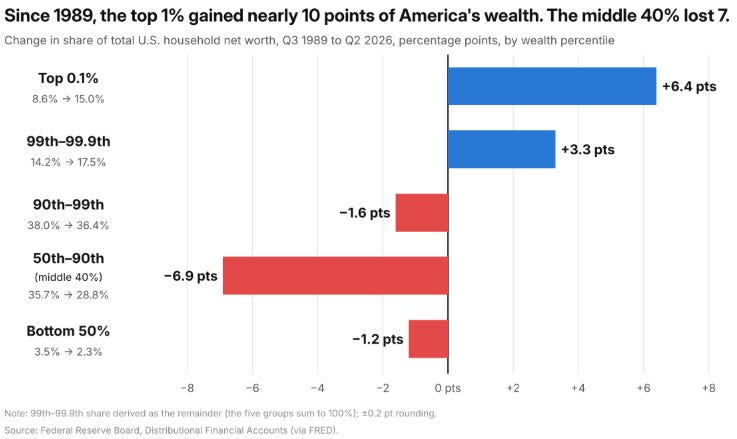
6. The Wealth Gap: If the top 1% keeps pulling ahead, is populism inevitable?
Since 1989, the richest 1% has gained nearly 10 points of America’s wealth (Federal Reserve). The top 0.1% alone now holds a record 15%. Start the clock in 2000 or 2009 and the pattern holds. Add corporate profits near a record share of GDP and workers’ share near a record low (Schwab), and you have the raw material of populism — left and right.
Great way to look at these issues, and as you note, they are different but not separate.
The biggest threat of all is the $2 trillion deficits, and since 50% or more of the deficit is interest on the debt, cuts in spending can’t easily be made. 65% increase in revenue over the past 10 years, and we still doubled the national debt … out of control.
Who’s voting for higher taxes, open borders and more fraud? Polls are once again, misreading American voters.